

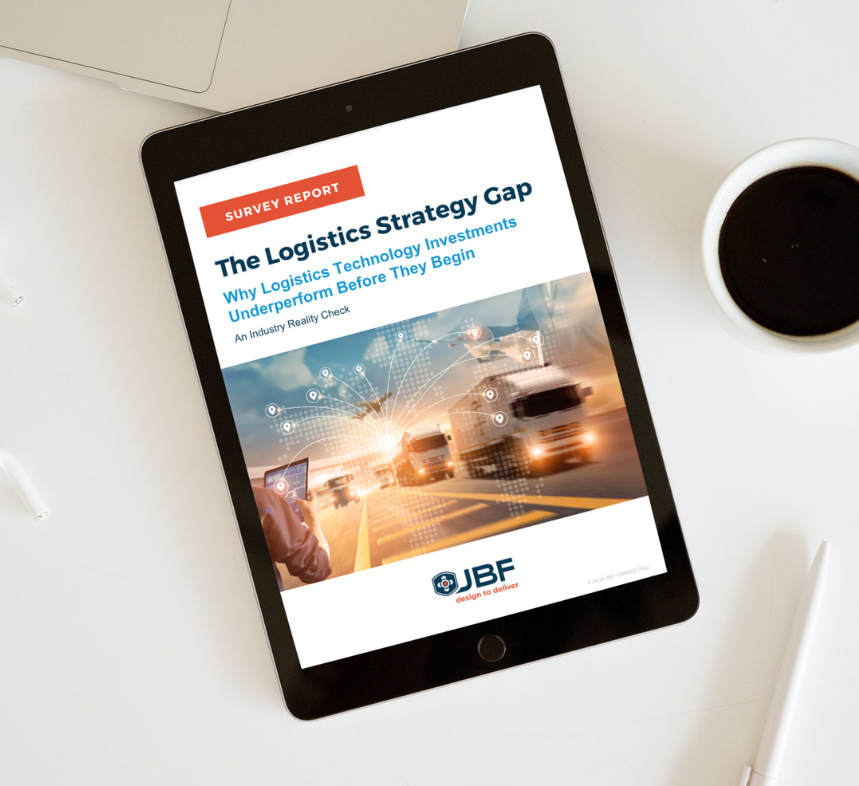
New Survey Reveals Opportunity to Strengthen Alignment Between Supply Chain Strategy and Technology Investment
Nearly 42% of senior leaders report limited confidence in independently evaluating complex logistics technology investments
GUILFORD, CT – (March 10, 2026) – JBF Consulting, a leading logistics strategy advisory and technology integration firm, announced today the findings from a recent industry survey highlighting opportunities for organizations to better align supply chain strategy with technology investment decisions. Notably, nearly 42% of respondents reported being either “not very confident” or “not at all confident” in their organization’s ability to independently evaluate complex logistics technology options, underscoring the importance of structured, strategy-led decision-making processes. Click here to download the full report.
The Need for Independent Strategy
The online survey, presented to more than 2,000 senior supply chain, logistics, and technology leaders, indicates that while companies continue making significant investments in logistics and supply chain technology, many would benefit from a more clearly defined strategic roadmap to guide those decisions. An additional 32% of respondents selected a neutral response when asked about their evaluation confidence, suggesting that many organizations recognize the complexity of these decisions and see opportunity to further strengthen internal expertise.
Furthermore, the data showed that organizations sometimes frame operational challenges in terms of systems before fully defining the underlying operational challenge, whether process-related, structural, or systemic. More than one-quarter of respondents (27%) reported that their organizations frequently define supply chain problems in terms of tools, and another 22% said they often move toward identifying a system solution early in the process. Only 4% of respondents strongly agreed that their organization clearly distinguishes between a technology business case and a broader supply chain strategy. Strategic reviews themselves vary in frequency. While 25% of organizations review logistics or supply chain strategy annually and 36% conduct structured reviews every two to three years, 13% report reviewing strategy only in response to major disruptions such as mergers, acquisitions, or regulatory shifts.
The research also suggests room for enhancing the rigor and consistency of business case development. Nearly four in ten respondents (38%) described their business case process as primarily focused on confirming a direction that had already gained alignment. While 39% said business cases are developed internally, many characterized the process as time-intensive and evolving rather than standardized. Only 13% reported applying highly structured financial methodologies when evaluating major logistics technology investments, pointing to an opportunity for more formalized evaluation frameworks.
C-Level Realignment on Redefining Strategic Need
Leadership concerns center largely on implementation complexity and long-term value realization. When asked about potential missteps in new logistics technology investments, 28% cited overinvesting in capabilities that may go underutilized, while 27% expressed concern about integration complexity. Vendor flexibility was another consideration, with 23% noting the importance of selecting partners that can scale and evolve alongside business growth. Despite the operational nature of these tools, internal IT or technology teams most frequently lead strategy and requirements definition work (27%), followed by cross-functional teams (23%), highlighting the importance of collaboration across business and technology functions.
“This survey underscores the importance of taking an independent, strategy-first approach to supply chain transformation,” said Brad Forester, CEO of JBF Consulting. “Organizations today are investing in powerful technology capabilities. Ensuring those investments are grounded in clear strategic priorities, rigorous business case development that evaluates build, buy, and enhancement alternatives, disciplined evaluation free from vendor bias, and cross-functional alignment can significantly improve long-term outcomes.”
For more information about this survey data and to explore the key findings in greater detail, please click here to download the full report.
Read Supply & Demand Chain’ Takeaways
About JBF Consulting
JBF Consulting is a leading logistics strategy advisory and technology integration firm that partners with shippers to transform their logistics and supply chain execution operations. We empower clients to achieve operational efficiency and scalable, sustainable value through strategy development, roadmap orchestration, unbiased technology selection, expert implementation, data-driven insights, and ongoing managed services. For over two decades, our client-centric approach and partnerships with best-of-breed solution providers have ensured that every strategy and solution we deliver drives measurable impact, long-term success, and customer satisfaction.
