

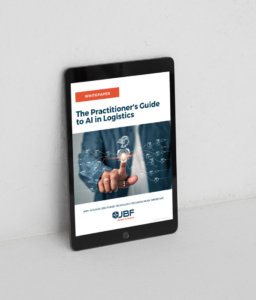
Download our Whitepaper, The Practitioner's Guide to AI in Logistics.
AI has become a board-level mandate for supply chain and logistics organizations faster than most internal processes have caught up. Budgets are moving, and pilots are launching under real pressure to show progress. We wanted to see what AI adoption looks like in the industry, so we surveyed 215 supply chain and logistics leaders. The results were telling.
78% are pursuing AI without a documented plan, and only 3% return afterward to compare results against the business case that justified the investment. At JBF, we call this the AI Discipline Gap: the distance between how fast an organization adopts AI and how much structure surrounds that adoption.
Five Questions Every Shipper Is Already Working Through
Every organization JBF talks with, regardless of how far along its AI program is, is working through some version of the same five questions:
- Where does AI create real value?
- How do you evaluate an AI vendor's demo?
- How do you build a business case that survives scrutiny?
- How do you put AI into operation responsibly?
- How do you sustain and scale the results?
None of those questions has a purely technical answer, and none gets easier by waiting for the market to settle. Our new guide, The Practitioner's Guide to AI in Logistics, walks through all five with data from our recent survey behind it and the judgment a vendor pitch won't supply.
FAQs
What is the AI Discipline Gap?
The AI Discipline Gap is JBF Consulting's term for the distance between how quickly organizations adopt AI and how much planning, governance, and measurement surrounds that adoption. In JBF's 2026 survey of 215 supply chain and logistics leaders, 78 percent were pursuing AI without a documented plan, and only 3 percent checked results against the original business case.
Most don't have one yet: JBF Consulting's 2026 survey of 215 supply chain and logistics leaders found that 78 percent are pursuing AI without a documented plan, and only 8.6 percent say AI is integrated into their broader business strategy.
Most logistics software, including TMS platforms, is priced against a fixed subscription or a volume tier that resets once a year. Many AI tools are priced by token, API call, or compute usage instead, so the cost tracks usage in real time. A pilot that looks inexpensive at low volume can produce a different cost profile once it's used daily, which is why a credible AI business case has to model cost as a variable rather than a flat number.
Not yet, for most organizations. JBF's 2026 survey found only 23 percent of supply chain leaders have AI running in live production, and just 10.5 percent have a formal, actively maintained governance framework once a system goes live. Public examples from companies furthest along, including C.H. Robinson, still describe AI agents scoped to specific functions working alongside people rather than replacing oversight entirely.
The answer depends on where the actual gap sits. JBF's research found that supply chain leaders most often want outside help with preparing data and technical architecture, planning implementation, and measuring outcomes, rather than understanding what AI is at a conceptual level. Building that capability from scratch usually costs more, in time and missed opportunity, than accessing it through a partner who already has it.
