

Here's a costly pattern: A supply chain executive faces pressure to "modernize." The team rushes to RFPs, sits through vendor demos, and builds ROI models…all before defining what success actually requires. Eighteen months later, technology is live, but results disappoint.
The problem wasn't the software. It was treating technology buying as strategy.
Here's the reality: Technology buying isn't strategy; it's an initiative deriving from strategy. Buying can absolutely be the right initiative, but it's one option among many: process redesign, operating model changes, labor strategy, network optimization, data governance, supplier alignment.
When you start with buying before validating strategy and defining key capabilities, you're not making a disciplined investment; you're running an expensive experiment.
When buying becomes the starting point, three failure patterns emerge:
- You outsource requirements to a demo — The "problem" becomes whatever the vendor wants to show you.
- You outsource ROI to a calculator — Benefits sound compelling but aren't grounded in your baseline, constraints, or adoption reality.
- You discover governance too late — Trade-offs, priorities, and operating cadence arrive after implementation is underway, when changes are expensive and political.
Strategy, Demystified: What It Is and What It Isn't
Strategy is one of the most misused words in business. It gets applied to visions, goals, initiatives, and technology purchases interchangeably. That confusion is expensive.
The good news is that strategy's definition is simple: it's a response to a challenge.
Richard Rumelt's framing is the clearest: good strategy has three parts - diagnosis, guiding policy, and coherent actions. If any piece is missing, you don't have a strategy. You have a goal, a hope, or a to-do list. Building on Rumelt's framework, here are the four elements that connect strategic thinking to capability building:
1. Diagnosis
A diagnosis defines the critical challenge. It simplifies messy reality by naming what actually matters, and just as importantly, what doesn't. Bad strategy skips this step, jumping straight to goals ("we need to grow 20%") or tools ("we need a new WMS") without naming the obstacle.
Example: "Our biggest constraint is unreliable inbound flow. Variability in supplier performance and receiving execution creates downstream chaos: expedites, stockouts, and firefighting. This erodes margin and burns out teams."
2. Guiding Policy
A guiding policy is your overall approach to addressing the challenge. It sets direction, defines boundaries, and makes tradeoffs explicit. This is where "what we will do" meets "what we won't do." If you haven't made tradeoffs, you don't have a guiding policy; you have a wish list.
Example: "We will prioritize inbound reliability over inbound flexibility. We will hold suppliers accountable to tighter windows, invest in receiving capacity and discipline, and accept that this may reduce short-term agility with smaller vendors."
3. Strategic Outcomes (North Star)
Strategic outcomes are measurable expressions of success that keep actions aligned over time. They translate "what winning looks like" into terms you can track, prove, and hold people accountable to. If your North Star can't be measured, it's a slogan. If it isn't tied to the diagnosis and guiding policy, it's a distraction.
Example: "Achieve 96% inbound OTIF and reduce expedite spend by 40% within 18 months."
4. Capability Building (Coherent Actions)
For strategy to be actionable, you need capabilities. A capability is an organizational ability to do something reliably and repeatably. Capability building implements the guiding policy through a combination of process, people, technology, data, and governance. Capabilities reinforce each other. They're not disconnected projects or software systems. They're a system of choices designed to solve the diagnosed problem through consistent execution.
Example:
— Implement supplier scorecards with consequences tied to inbound OTIF
— Redesign appointment scheduling to reduce dock congestion
— Stand up a cross-functional "flow team" with authority to resolve receiving exceptions same-day
Benchmarking matters here. Before building capabilities, benchmark against peer and innovative industries. This provides context you can't get from internal debate. It helps distinguish what technology can influence versus what requires structural change, and prevents chasing incremental gains that won't move the needle.
Everything Else is Plan
Roadmaps.
Project plans.
RFPs.
Vendor selection.
Implementation schedules.
These belong to the plan, not the strategy. In that plan, technology buying has a proper place as a plan-level initiative that enables a capability. It is not the capability, and it is certainly not the strategy. When organizations skip diagnosis, guiding policy, strategic outcomes, and capability design, technology becomes the default. That's how you end up selecting tools before defining what you need to accomplish. Success gets measured by go-live dates instead of business outcomes.
The Translation Chain: How Strategy Becomes Smart Buying
A strategy-first approach forces answers to foundational questions before you shop:
— What strategic problem are we solving?
— Which outcomes do we expect to improve?
— What capabilities must exist to deliver value?
— What is the best way to build each capability?
— How will this investment change behaviors, processes, and accountability?
If those are unclear, the organization isn't "behind"—it's simply not ready to buy.
Buying regardless is how multi-year mistakes get made.
The Sequence That Produces Buying Decisions That Hold Up
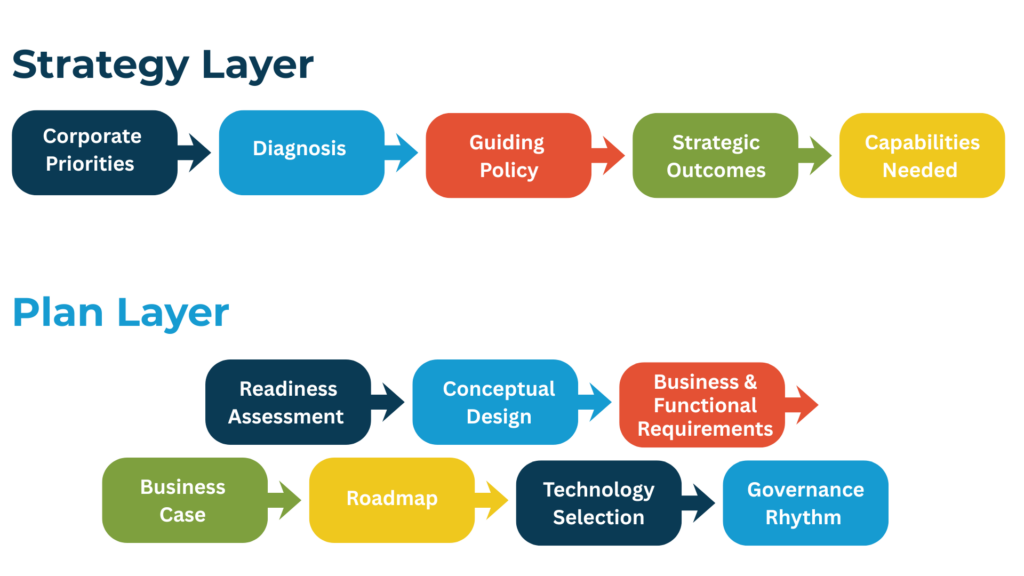
Notice: "Pick a system" is not step one.
This strategy-first standard positions you to anchor business requirements, business cases, and RFPs to what matters most. Buying becomes centered on problem-solving, capability-building, and improved outcomes—not features and vendor promises.
Why the Business Case Matters More Than Ever
Most technology failures are not vendor failures. They're strategy failures made early, invisibly, and paid for later in rework, workarounds, and missed ROI. A strategy-first approach doesn't slow decision-making, rather it improves it. It eliminates false starts, clarifies tradeoffs, and grounds ROI in capability and value rather than optimism and feature lists.
The discipline is simple: Define the challenge. Choose your approach. Set measurable outcomes. Design the capabilities. Then, and only then, determine if buying technology is the right way to build those capabilities. When you get the sequence right, technology buying becomes what it should be: a powerful enabler of strategy, not a substitute for it.
Ready to ground your next technology investment in strategy? At JBF Consulting, we help teams build business requirements that tie directly to their strategic outcomes and prioritize capabilities before they shop. Contact us today to learn how our proven approach can deliver measurable benefits for your organization.
About the Author
Tara Buchler is Principal, Strategy at JBF Consulting, bringing more than 20 years of experience at the intersection of logistics operations and enterprise supply chain software. She partners with shippers to design and implement pragmatic, high-impact strategies that align business goals with advanced technology solutions.
Tara’s unique perspective blends vendor-side product leadership, hands-on implementation expertise, and operational insight—allowing her to provide objective advisory services rooted in real-world experience. Her background includes senior roles at e2open, BluJay Solutions, and LeanLogistics, where she helped shape TMS, visibility, and parcel execution capabilities for global shippers.
FAQs
A strategy-first approach means defining the diagnosis, guiding policy, measurable outcomes, and required capabilities before launching initiatives like technology purchases. Instead of starting with tools, organizations clarify the problem they are solving and the outcomes they expect to achieve. Technology buying becomes an initiative derived from strategy—not a substitute for it.
Most technology implementations fail because organizations skip foundational strategy steps. When companies move directly to vendor selection or ROI modeling without a clear diagnosis, guiding policy, and defined capabilities, requirements become vague and success metrics become misaligned. The result is software that goes live but does not materially improve business outcomes.
Strategy defines the challenge, approach, and desired outcomes. A plan defines how those choices will be executed. Strategy answers “What problem are we solving and why?” while the plan answers “How will we implement and govern the solution?” Roadmaps, RFPs, business cases, and vendor selection belong to the plan layer—not the strategy layer.
Before purchasing technology, organizations should define the capabilities required to achieve their strategic outcomes. A capability is the ability to execute something reliably and repeatedly—often involving process, people, data, governance, and technology working together. Technology should only be selected after the organization determines the most effective way to build each required capability.
Business requirements should be directly traceable to strategic outcomes and the underlying diagnosis. Each requirement should answer:
-
Which strategic outcome does this support?
-
Which capability does it enable?
-
What measurable improvement will it drive?
If a requirement cannot be linked to a defined capability and outcome, it likely reflects a feature preference rather than a strategic necessity.
